INTRO — Some Songs Aren’t Just Sung… They’re Survived
There are songs that entertain.
Songs that soothe.
Songs that drift quietly into the background.
And then there are the other songs—
the ones born in blood,
written in grief,
carried by those that have gone on before us,
and destined to outlive their singers.
“The Hanging Tree” is one of them.
A melody that was never meant to be comforting.
A warning that became a weapon.
A love story that became a rebellion.
And at the center of it all:
a girl with a guitar,
a condemned man,
and a forest that remembers everything.
PART I — The Night Arlo Chance Was Taken
Before it was an anthem,
before mockingjays carried it through shattered districts,
before it echoed through the mountains behind Katniss Everdeen…
“The Hanging Tree” was simply a girl’s grief wrapped in melody.
Lucy Gray Baird witnessed the execution of Arlo Chance —
a miner accused of causing an explosion that took three lives.
Dragged through the Meadow,
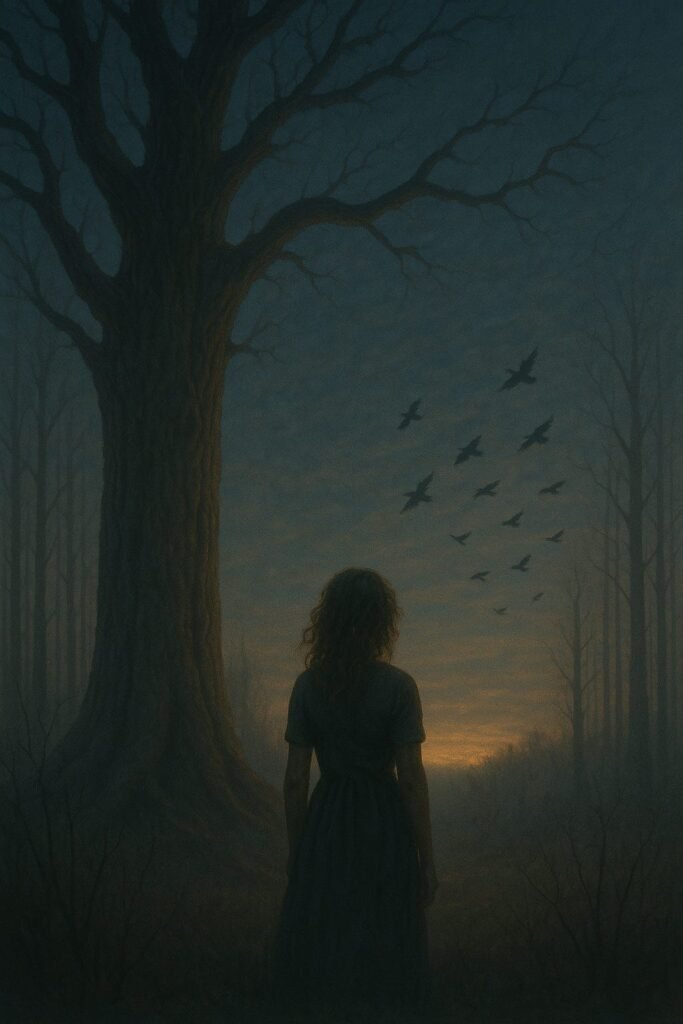
bound beneath the branches of the old hanging tree,
Arlo faced the fate no man returns from.
And yet…
in those final moments,
his voice was the only thing not afraid.
When his lover Lil stepped forward — desperate, pleading —
he didn’t ask her to wait.
He didn’t tell her to fight.
He didn’t beg her to hold on.
He shouted one word through the chaos:
“RUN!”
But the Meadow had already chosen his fate.
Moments later, the rope tightened.
The crowd fell silent.
And something ancient — something tragic — settled into the bark of that tree.
But the story didn’t end there.
Because the jabberjays and mockingjays never forget.
They echoed Arlo’s final cry.
They repeated Lil’s gasp of horror.
They turned the execution into a song —
one the birds sang long after the humans had gone home.
Nature carried the heartbreak.
The forest kept the memory.
And Lucy Gray wrote the verses that would outlive them all.
PART II — “Are You, Are You, Coming to the Tree?”
A lover’s invitation… from the tree.
At first listen,
the lyrics sound like a lover calling his beloved to a secret meeting.
A romance whispered through branches.
But then the meaning shifts.
Darkens.
Turns.
The invitation comes from the man who’s already been hanged —
his voice lingering in the leaves.
What was meant to be a warning becomes an eerie plea:
Come join me.
Come finish what we began.
Come defy the fear that killed me.
It is chilling.
Haunting.
But also strangely holy —
a reminder that love and courage sometimes look the same.
Lucy Gray wrote more than a song.
She wrote a memorial.
A coded message.
A prophecy.
PART III — The Song the Capitol Feared
When Coriolanus Snow first heard “The Hanging Tree,”
He heard a threat.
A message of resistance
disguised as a ballad.
A whisper that could ignite a match.
A melody that could unify the broken.
Commander Hoff knew it too.
He banned Lucy Gray from singing it —
because it was “too dark,”
but the truth was simpler:
It was too rebellious.
Too alive.
Too dangerous.
Music is memory.
Music is movement.
Music is protest written in a different language.
When time passed,
the Hob was shut down.
Music forbidden.
Silence enforced.
But the song could not be silenced.
Mockingjays carried it.
The forest protected it.
And decades later, Katniss Everdeen would pick up that melody —
not knowing its origin,
but feeling its fire.
When she sang it,
the rebellion realized:
The Capitol could control districts.
They could control food.
Jobs.
Punishment.
Death.
But they could not control a song.
PART IV — The Hanging Tree Becomes a War Cry
“The Hanging Tree” became more than a ballad.
More than Lucy Gray.
More than Arlo Chance.
It became:
A rallying cry.
A coded signal.
A sign of unity.
A symbol of martyrdom.
And perhaps most dangerous to the Capitol…
a reminder that once people stop fearing death,
tyranny loses its power.
The rebellion didn’t just sing it.
They became it.
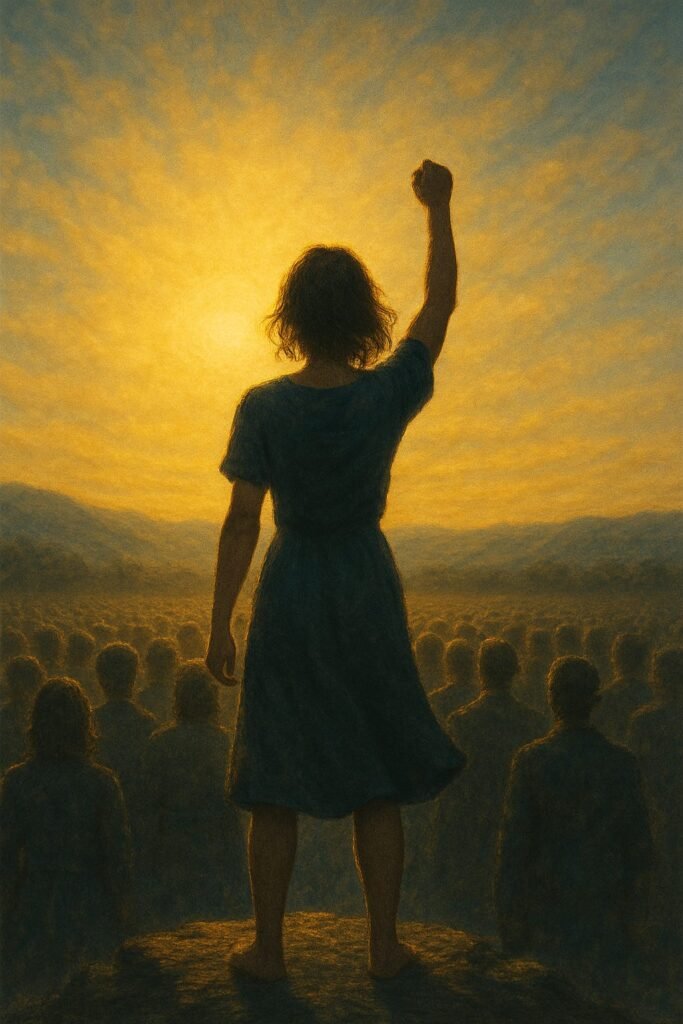
A forest of people willing to stand,
even if it cost everything.
A movement no longer afraid to hang
because they had already died inside the system.
Arlo’s final cry — “run!” —
became the anthem of a revolution determined never to run again.
REFLECTION — Why This Song Still Matters
Songs like “The Hanging Tree” exist in every generation:
songs that rise from injustice,
songs whispered by survivors,
songs carried by those who refuse to let history be erased.
It reminds us that:
The oppressed always find a voice.
The truth always finds a melody.
And courage always grows in the shadow of fear.
This is more than fiction.
It’s the pattern of history.
The pattern of humanity.
The pattern of hope.
Because some songs are not just sung —
they’re inherited.
POETIC ENDING — The Tree Still Stands
And maybe that’s the haunting beauty of it:
The Capitol fell.
The Meadow grew back.
But the song remains.
Still echoing.
Still remembering.
Still calling.
Are you, are you, coming to the tree?
It’s no longer a call to death.
Now it’s a call to courage.
A call to remembrance.
A call to stand tall where injustice tried to silence a voice.
Some songs never die.
Because truth never does.
DECLARATION — Rise. Rebuild. Become.
I choose courage over comfort.
I choose truth over silence.
I choose to stand where others fell.
For such a time as this…
I refuse to bow.
I rise.